Quick Answer: Bodyweight Pull Exercises train your back, biceps, rear delts, traps, and grip using pull-ups, rows, floor pulls, and calisthenic progressions. You can build a strong pull day at home with a table, towel, and doorframe by using a slower tempo, holds, and controlled reps.
Key Takeaways
- Pulling movements balance all the pushing that most home workout routines already have, which protects posture and shoulder health.
- You can train every pulling muscle at home using a table, a doorframe, a towel, or just the floor.
- Progress by adding reps and sets, slowing the lowering phase, holding the hardest position, and moving to harder variations.
- A solid pull day needs a vertical pull, a horizontal row, a rear delt move, a biceps or grip drill and a warm-up activation drill.
Truth About Bodyweight Pull Exercises
Bodyweight Pull Exercises are slightly more complicated because a lot more movement patterns to cover. And we often see people struggling with certain muscles when they’re trying to target them specifically I’ve seen this firsthand whilst working with people on the gym floor, especially the lats, where people struggle, but that’s most pulled-up movements and rowing movements. And this often happens because we don’t use them in day-to-day life. But just remember that trying to target your lats is quite challenging.
Pulling exercises share a common set of working muscles:
- Latissimus dorsi (the big back muscles that create width).
- Rhomboids (between the shoulder blades, they pull the blades together).
- Trapezius (upper, mid, and lower back support).
- Rear delts (the back of the shoulders).
- Biceps (the main arm pullers).
- Forearms and grip.
- Core stabilisers that keep the body tight during the pull.
“To improve your posture, strengthen the muscles of your back, shoulders, and core that hold you upright.”
Harvard Health Publishing, Harvard Medical School
30 Best Bodyweight Pull Exercises
Here are 30 of the best pull workout exercises, grouped from vertical pulls to horizontal rows to floor work and advanced skills. Each one lists who it is best for, how to do it, sets and reps, and one coaching tip. Pick the moves that match your level and build your own pull day exercises list from them.
1. Standard Pull-up

- Best for
- Lats, upper back, grip
- How
- Hang from a bar with palms facing away. Pull your chest toward the bar, keep your ribs down, then lower with control.
- Sets and reps
- 3 sets of 4 to 8 reps. Beginners can do 3 sets of negatives instead.
- Tip
- Avoid swinging and keep your shoulder blades active throughout.
2. Chin-up

- Best for
- Biceps, lats, lower traps
- How
- Use an underhand grip. Pull until your chin clears the bar, then lower slowly.
- Sets and reps
- 3 sets of 5 to 10 reps.
- Tip
- Chin-ups usually feel easier than pull-ups because the biceps help more.
3. Commando Pull-up

- Best for
- Lats, biceps, core rotation control
- How
- Hold the bar with both hands facing each other on one line. Pull your head to one side of the bar, then alternate sides.
- Sets and reps:
- 3 sets of 4 to 6 reps per side.
- Tip
- Keep your body tight to avoid twisting too much.
4. Wide-Grip Pull-up

- Best for
- Upper lats and upper back width
- How
- Hold the bar wider than shoulder width. Pull your elbows down and back.
- Sets and reps
- 3 sets of 3 to 8 reps.
- Tip
- Do not go too wide if it hurts your shoulders.
5. Close-Grip Chin-up

- Best for
- Biceps and lower lats
- How
- Use a narrow underhand grip. Pull up smoothly and lower with control.
- Sets and reps
- 3 sets of 6 to 10 reps.
- Tip
- Keep your elbows close to your ribs.
6. L-Sit Pull-up

- Best for
- Lats, abs, hip flexors, grip
- How
- Hang from the bar, raise your legs straight in front, then perform a pull-up while holding that L shape.
- Sets and reps
- 3 sets of 3 to 6 reps.
- Tip
- Start with tuck L-sit pull-ups if straight legs are too hard.
7. Negative Pull-up

- Best for
- Beginners building pull-up strength
- How
- Jump or step to the top position, then lower yourself for 3 to 5 seconds.
- Sets and reps
- 3 to 5 sets of 3 to 5 reps.
- Tip
- Control the lowering phase instead of dropping quickly. Slow negatives are one of the fastest ways to earn your first pull-up.
8. Assisted Band Pull-up

- Best for
- Beginners and higher-volume practice
- How
- Loop a resistance band around the bar and place one foot or knee inside, then pull up with control.
- Sets and reps
- 3 sets of 6 to 10 reps.
- Tip
- Move to a lighter band over time so the band does less of the work.
9. Towel Pull-up

- Best for
- Grip, forearms, lats
- How
- Loop a towel over a bar, grip both ends, and pull your body upward.
- Sets and reps
- 3 sets of 3 to 6 reps.
- Tip
- Start carefully because grip fatigue comes fast.
10. Archer Pull-up

- Best for
- Advanced one-arm strength preparation
- How
- Use a wide grip. Pull toward one hand while the other arm stays straighter, then alternate sides.
- Sets and reps
- 3 sets of 3 to 5 reps per side.
- Tip
- Master strict pull-ups before trying this.
11. Standard Inverted Row

- Best for
- Upper back, biceps, posture
- How
- Lie under a stable bar or table. Pull your chest toward the edge, then lower.
- Sets and reps
- 3 sets of 8 to 12 reps.
- Tip
- Keep your body straight like a plank from head to heels.
12. Feet-Elevated Inverted Row

- Best for
- Harder horizontal pulling
- How
- Put your feet on a chair or bench and perform an inverted row.
- Sets and reps
- 3 sets of 6 to 10 reps.
- Tip
- Elevating the feet increases difficulty, so add it once flat rows feel easy.
13. Tuck Inverted Row

- Best for
- Beginners
- How
- Bend your knees and keep your feet closer to your body while rowing.
- Sets and reps
- 3 sets of 10 to 15 reps.
- Tip
- The more upright your body, the easier it becomes, so it is an easy on-ramp.
14. Archer Inverted Row

- Best for
- Unilateral back strength
- How
- Pull your chest toward one hand while extending the other arm more, then alternate sides.
- Sets and reps
- 3 sets of 5 to 8 reps per side.
- Tip
- Move slowly and avoid dropping one shoulder.
15. Table or Doorway Row

- Best for
- A pull workout at home with no kit
- How
- Hold a sturdy table edge or doorframe, lean back, and row your body forward.
- Sets and reps
- 3 sets of 8 to 15 reps.
- Tip
- Check stability before every set so nothing tips or slides.
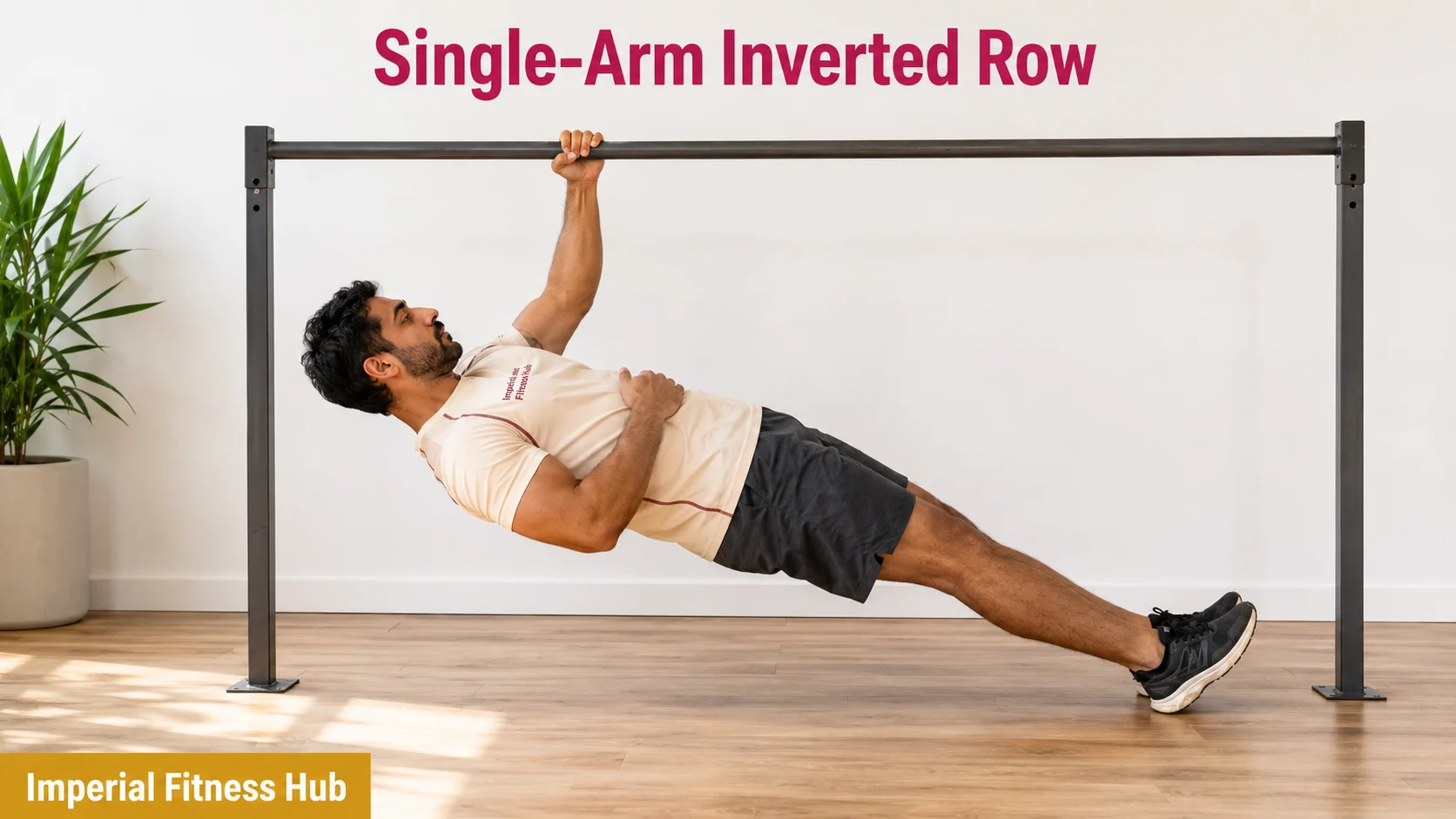
16. Single-Arm Inverted Row
- Best for
- Advanced back and biceps control
- How
- Set up under a bar or rings and row with one arm while keeping your hips square.
- Sets and reps
- 3 sets of 3 to 6 reps per side.
- Tip
- Start with your body more upright, then lower the angle as you get stronger.
17. Scapular Pull-up

- Best for
- Shoulder blade control and pull-up warm-up
- How
- Hang from a bar with straight arms and pull your shoulder blades down, then relax.
- Sets and reps
- 2 to 3 sets of 8 to 12 reps.
- Tip
- Do not bend the elbows. This small move teaches the shoulder control every pull needs.
18. Front Lever Row

- Best for
- Advanced lats, core and straight-body strength
- How
- Hold a tucked or advanced tuck front lever position and row your chest toward the bar.
- Sets and reps
- 3 sets of 3 to 6 reps.
- Tip
- Start with tuck front lever rows before opening the body out.
19. Superman Pull

- Best for
- Lower back, upper back, rear delts
- How
- Lie face down. Lift your chest slightly, reach your arms forward, then pull your elbows toward your ribs.
- Sets and reps
- 3 sets of 12 to 15 reps.
- Tip
- Move slowly and squeeze the back at the top. This is a key no-equipment back move.
20. Reverse Snow Angels

- Best for
- Rear delts, traps, posture
- How
- Lie face down with arms by your sides. Sweep your arms overhead and back without rushing.
- Sets and reps
- 2 to 3 sets of 12 to 15 reps or 30 seconds.
- Tip
- Keep your thumbs slightly up to open the shoulders.
21. Plank Rows

- Best for
- Core, lats, shoulder stability
- How
- From a high plank, drive one elbow back as if rowing, squeeze the shoulder blade, then switch sides.
- Sets and reps
- 3 sets of 8 to 12 reps per side.
- Tip
- Keep your hips still so the back does the work, not the twist.
22. Seated Bodyweight Pulldown

- Best for
- Lat activation without a machine
- How
- Sit tall with your arms overhead. Pull your elbows down toward your ribs while squeezing the lats hard.
- Sets and reps
- 3 sets of 15 to 20 slow reps.
- Tip
- This is the best pull-down exercise without machine access. Use it as a warm-up or a no-equipment finisher.
23. Lying Y/T/W Raises

- Best for
- Rear delts, mid-back, and shoulder health
- How
- Lie face down and raise your arms into Y, T, and W positions while squeezing the upper back.
- Sets and reps
- 2 to 3 rounds of 8 to 10 reps in each position.
- Tip
- Use small, controlled movements rather than big swings.
24. Bicep Leg Curl

- Best for
- Biceps without weights
- How
- Sit down, place one hand under the opposite thigh, and curl your arm upward while your leg gives resistance.
- Sets and reps
- 3 sets of 10 to 15 reps per arm.
- Tip
- Make the leg push back hard enough to truly challenge the biceps. This is one of the simplest arm pull exercises you can do anywhere.
25. Muscle-up

- Best for
- Explosive pull strength and transition power
- How
- Pull hard above the bar, lean your chest over, then press to the top.
- Sets and reps
- 3 to 5 sets of 1 to 4 reps.
- Tip
- Build strict pull-ups and chest-to-bar pulls first.
26. Back Lever

- Best for
- Straight-arm pulling strength, shoulders, and core
- How
- Hang from a bar, rotate into an inverted position, then lower into a straight-body hold facing the floor.
- Sets and reps
- 3 to 5 holds of 5 to 15 seconds.
- Tip
- Start with tuck back lever holds and open up slowly over weeks.
27. Front Lever

- Best for
- Lats, core, straight-arm strength
- How
- Hang from a bar and raise your body until it is parallel to the floor, facing up.
- Sets and reps
- 3 to 5 holds of 5 to 12 seconds.
- Tip
- Use tuck, advanced tuck, and one-leg progressions on the way to the full hold.
28. Typewriter Pull-up

- Best for
- Advanced side-to-side pulling
- How
- Pull to the top of a wide pull-up, shift your body from one hand to the other, then lower.
- Sets and reps
- 3 sets of 2 to 5 reps per side.
- Tip
- Keep the movement controlled rather than swinging across.
29. One-Arm Pull-up

- Best for
- Elite pulling strength
- How
- Hang from one arm and pull your body upward without twisting.
- Sets and reps
- 3 to 5 sets of 1 to 3 assisted reps per side.
- Tip
- Train assisted one-arm negatives first to build the tendons safely.
30. Side-to-Side Pull-up

- Best for
- Lats, biceps, and uneven pulling strength
- How
- Pull up, shift slightly toward one side, lower, then repeat on the other side.
- Sets and reps
- 3 sets of 4 to 8 total reps.
- Tip
- Use this before progressing to archer or typewriter pull-ups.
For a complete push-pull balance, pair this list with some bodyweight shoulder exercises on your other training days.
How to Progress Bodyweight Pull Exercises
The biggest mistake with home pull training is repeating the same workout and expecting change. Your body adapts, so the work has to get harder over time, and you do not need extra weight to do that. Here are ten ways to make Bodyweight Pull Exercises more demanding.
- Add reps to each set.
- Add an extra set.
- Slow the lowering phase so the muscle works longer.
- Pause and hold at the hardest point of the rep.
- Increase the body angle, for example, by lowering your feet during rows.
- Switch to a harder variation of the same move.
- Reduce band assistance step by step.
- Move from the two-arm to archer to the one-arm versions.
- Use a full range of motion on every rep.
- Track your weekly performance so you can see the trend.
That slow, controlled lowering phase matters more than most people think. The lengthening, or eccentric, part of a rep builds a lot of strength, which is why negatives work so well for a first pull-up.
“I fear not the man who has practiced 10,000 kicks once, but I fear the man who has practiced one kick 10,000 times.”
Bruce Lee
How Many Exercises Should You Do on Pull Day?
You do not need a long list to get results. The right number of pull day exercises depends on your experience and how well you recover. A focused session of well-chosen moves beats a sprawling one you cannot finish with good form.
| Level | Exercises per pull day | Focus |
|---|---|---|
| Beginner | 4 to 6 | Learn form, build base strength |
| Intermediate | 5 to 7 | Add volume and harder variations |
| Advanced | 6 to 8 | Skills, unilateral work and volume |
Seven exercises can be plenty if they cover the full range. A complete pull day workout usually includes one vertical pull, one horizontal row, one rear delt move, one biceps or grip drill, one progression or skill move, one lower-intensity finisher, and one warm-up activation drill. Hit those seven slots, and you have trained every pull day muscle group without wasting time.
Conclusion
Pulling work is the half of training most home routines forget, and fixing that gap pays off in posture, shoulder health and real upper-body strength. The best part is that you do not need a full gym. Bodyweight Pull Exercises let you train your back, biceps, rear delts, and grip with a bar, a table, a towel, a doorframe, or just the floor.
If you are starting out, begin with rows, floor pulls, and assisted or negative pull-ups, and focus on clean form before chasing numbers. As you get stronger, work up the ladder toward archer pull-ups, front lever rows, muscle-ups, and one-arm pull-ups. Whatever your level, the two things that decide your results are consistency and recovery, so train regularly, rest properly, and let the little progress add up.
Frequently Asked Questions
Q1. What muscles does pull day work?
Pull day works the back muscles (lats, rhomboids and traps), the rear delts, the biceps, the forearms and grip, and the core stabilisers. Any time you pull a load toward your body, or pull your body toward an anchor, these muscles fire together, which is why pulling balances out your pushing work.
Q2. How do you do a pull day with no equipment?
You can run a full pull day with no kit using moves like table rows, doorway rows, superman pulls, reverse snow angels, Y/T/W raises, and seated bodyweight pulldowns. Slow the lowering phase, pause at the hardest point, and use a full range of motion to keep the muscles under tension without weights.
Q3. Are 7 exercises enough for pull day?
Yes. Seven exercises are plenty when they cover a vertical pull, a horizontal row, a rear delt move, a biceps or grip drill, a skill or progression, a lighter finisher, and a warm-up activation drill. Coverage and quality matter far more than a long list.
Q4. How do you hit 30 pull-ups?
Build volume gradually with submaximal sets that stop short of failure, add negatives and rows for extra back work, and train grip so your hands do not give out first. Practise two to three times a week, avoid daily max tests, and prioritise recovery so the reps keep climbing.
Q5. Are bodyweight pull exercises good for women?
Yes. Pull workouts build upper-back posture, arm strength and grip for everyone, and the path is the same regardless of gender. Many women start with rows, scapular pulls and negatives, then progress to full pull-ups using the same step-by-step ladder anyone else would follow.